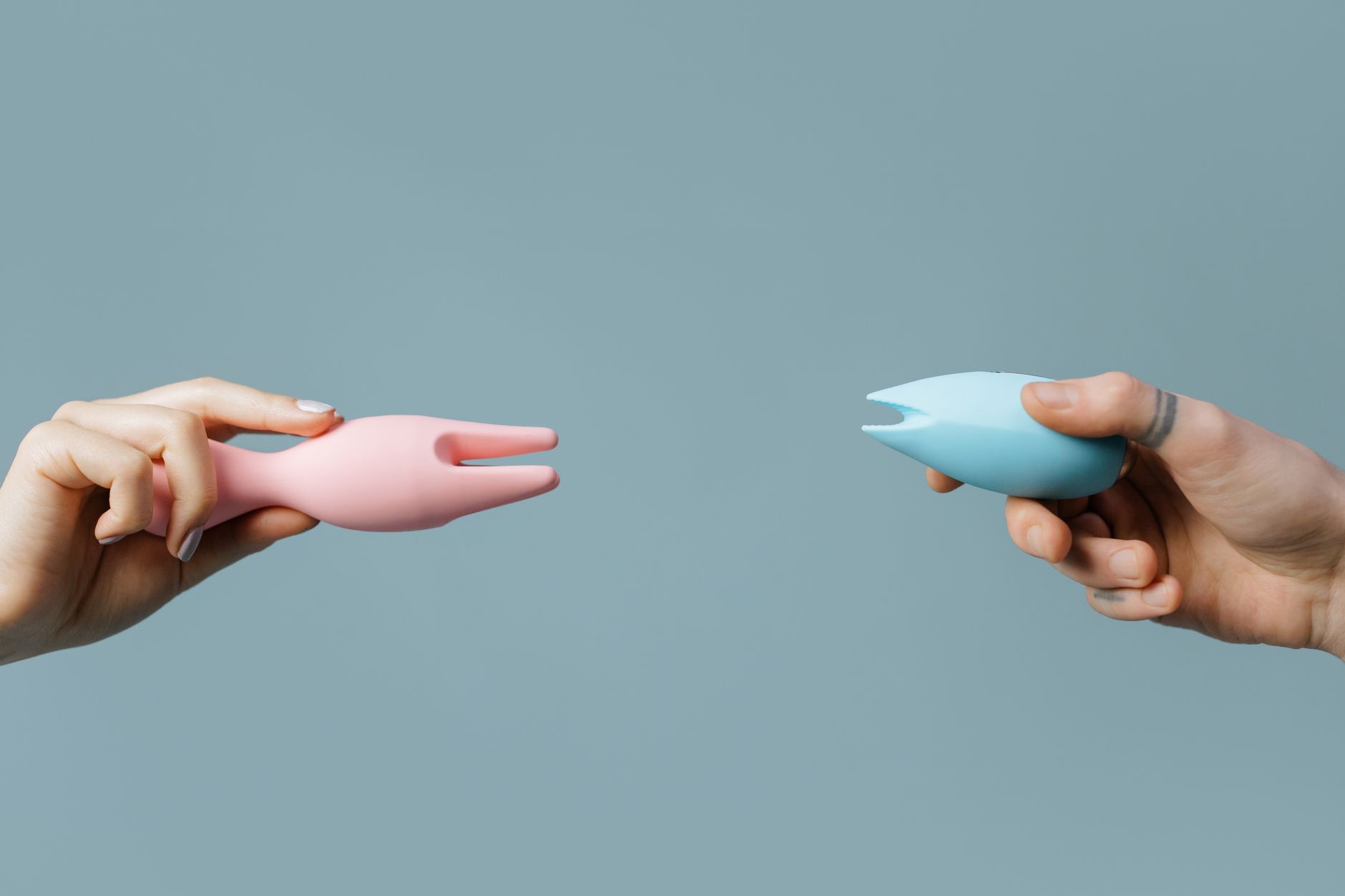
Let's start with the obvious
There's a massive difference between using a lemon vibrator alone and having a partner use one on you. It's not just about shared pleasure. The physical sensation changes. The intimacy changes. Sometimes the vulnerability changes everything.
Here's what actually happens when you hand over control, and why couples often report that partnered use of lemon clitoral vibrators feels like discovering pleasure for the first time.
The sensation shift is real and neurological
When you're using a device on yourself, your brain is managing two things at once: the physical stimulation and the motor control. Your hand is moving, your attention is divided, and your nervous system is tracking both input and output.
When a partner uses a lemon vibrator on you, that load drops entirely. Your body receives sensation without managing the movement. The neurological effect is measurable. Research on partnered touch shows that receptive stimulation activates different brain regions than self-directed stimulation. Your nervous system can fully receive instead of split between giving and receiving.
This isn't subtle. Many people describe partnered use of lemon clitoral vibrators as feeling more intense, more immediate, and sometimes almost new. That's not imagination. It's neurology.
Why the emotional experience transforms
Three layers happen simultaneously when a partner holds the device.
First, the trust piece. You're literally handing over control of your pleasure. That requires permission at a level that solo play doesn't demand. For some people, that vulnerability opens something. For others, it feels risky. Both reactions are normal.
Second, the attentiveness. A partner using a lemon vibrator on you can watch your face, adjust speed based on your breathing, respond in real time. They're attuned to you. That feedback loop doesn't exist in solo play. Your partner becomes part of the nervous system activation, not just an observer.
Third, the permission to receive. There's a particular kind of permission that comes from someone else deciding to pleasure you. It bypasses the guilt, the efficiency mindset, the voice that says "I should be doing something else." Your partner's attention becomes permission.
The practical shifts that matter
If you're introducing lemon sexual toys into partnered sex, four things change immediately.
Angle and pressure are different. When you're using a device on yourself, you have intuitive control. When a partner holds it, they're working from observation. The angle might be slightly off at first. The pressure might be lighter or heavier than you'd apply. This usually corrects in 30 seconds once they read your response, but the initial moment often surprises people.
Rhythm becomes external. You can't speed up or slow down with a micro-movement. Your partner controls the tempo. If they have a different instinct about pacing, that becomes apparent immediately. Some couples find they naturally sync. Others discover they have wildly different ideas about what feels good.
Placement requires conversation. Where exactly do you want it? Not everyone's anatomy is identical. A lemon clitoral vibrator that sits perfectly for one person might need repositioning for another. This is a detail that sounds clinical but lands intimate. You have to communicate about your own body in real time.
Coordination changes everything. If your partner is also stimulating you manually or with their mouth, the layering is entirely different. A lemon vibrator plus oral sex creates a sensation that's not additive. It's multiplicative. The two stimulations interact in ways that single-source stimulation doesn't. This is why couples often find that lemon vibrators paired with partnered touch feel revelatory.
How to introduce this without the awkward pause
Honestly? The best intro is matter-of-fact. Not "I have a surprise for us," which loads it with expectation. Not "Is it okay if I show you something," which makes it sound transgressive.
Try: "I've been using lemon vibrators for a while, and I'm curious what it would feel like if you used one on me." That's it. Honest, specific, no buildup.
The first time, your partner might be nervous about hurting you or doing it wrong. They might move too cautiously. Tell them directly what helps. "Faster" or "higher" or "just hold it there" gives them the feedback they need. Most people are actually relieved to have specific direction instead of guessing.
If you're on the receiving end and your partner wants to try this, the same principle applies. Ask questions. "Do you want me to move it or just keep it in one place?" "Should I check in with you every few seconds or just go with what I see?" These details transform an awkward situation into collaborative pleasure.
The conversation before matters more than you think
Here's where couples actually struggle. It's not the physical logistics. It's the assumption that one person should just know how to use a lemon clitoral vibrator on someone else.
Take 10 minutes and actually talk about what you're both hoping for. Is this about adding intensity? About deepening intimacy? About giving your partner the experience of receiving while you focus on pleasure? Different intentions create different experiences.
Also discuss boundaries. Are there moments when you want to keep control? Does stopping the device feel jarring or welcome? If your partner uses a lemon vibrator during sex, does that change the dynamic in ways you want or don't want?
These conversations feel awkward in the moment. They're the opposite of awkward once you're actually in it. Partners who can talk about the specifics beforehand report significantly better experiences. No mystery, no misalignment.
When partnered use reveals desire mismatches
Here's something nobody warns you about: sometimes introducing lemon sexual toys into partnered sex clarifies that you and your partner have different ideas about what feels good or what you both want.
One partner might love the intensity of a lemon vibrator during penetrative sex. The other might feel it changes the experience in a way that doesn't work for them. One person might want their partner to use it during foreplay. The other might want it incorporated into the main event.
These aren't problems. They're information. If you've never named what you each actually want, a lemon clitoral vibrator can be the thing that brings it to the surface. That's useful.
If desire or pleasure preferences genuinely don't align, talking with a couples therapist who specializes in sexual health can help. But plenty of couples find that working through these preferences together actually deepens their connection. It's not "we have to agree on everything." It's "let's figure out what works for both of us."
The sensation you might not expect
Many people report that when a partner uses a lemon vibrator on them, the orgasm feels different. Not better or worse. Different. Sometimes more full-body. Sometimes more localized but deeper. Sometimes it arrives faster.
That variation is normal. Your body's response to external stimulation doesn't work the same way as solo stimulation. Your nervous system is activating differently. The arousal builds from a different starting point. Your partner's presence changes the entire experience.
Some couples find that partnered use of lemon clitoral vibrators becomes their preferred way. Others use them both ways and get different benefits from each. Neither is right. It's just about discovering what your body actually responds to.
When to loop a partner in if you're solo
If you've been using lemon vibrators alone and want to invite a partner into that experience, the transition doesn't have to be complicated.
Start by mentioning it casually. You might already have a solo routine with a lemon clitoral vibrator. That's your baseline. The partnered version is an addition, not a replacement. You can suggest it during a moment when you're already intimate, or you can bring it up separately when you're not in the moment. Both approaches work.
What matters: your partner knows this isn't about them not being enough. Lemon sexual toys aren't criticism. They're expansion. They're you saying "I want to explore more pleasure, and I want you here for it."
That distinction changes the entire tenor of the conversation.
FAQ
Can my partner hurt me if they use too much pressure with a lemon vibrator?
Lemon clitoral vibrators are designed for gentle stimulation. The sensation builds gradually, and you can communicate in real time if something feels like too much. Your partner can see your face and adjust immediately. It's actually harder to accidentally cause discomfort than with manual touch because the device itself provides the intensity, not their hand strength.
What if my partner doesn't enjoy using a lemon vibrator on me?
That's valid. Some people find it awkward to hold or operate. Some prefer hands-on touch. Some don't love being in control of someone else's pleasure. You can use lemon vibrators solo while your partner uses other forms of stimulation with you. Pleasure doesn't have to look identical to feel connected.
Is using a lemon vibrator during partnered sex normal?
Completely. Plenty of couples incorporate clitoral vibrators into sex specifically because it changes the sensation for the receiving partner. Some people orgasm more reliably with external stimulation during sex. Adding a lemon vibrator can be the thing that makes partnered sex feel fully satisfying.
How do I tell my partner I want them to use a lemon clitoral vibrator on me?
Directly and matter-of-factly. "I'd like to try having you use a vibrator on me" is enough. You don't need to build narrative around it. If you want to pick a specific device like a lemon vibrator, show them, explain why it appeals to you, and ask if they're willing to explore it together. Most partners are curious if you're straightforward.
Will my partner feel replaced or inadequate if I want to use lemon vibrators together?
Not if you frame it correctly. Lemon sexual toys aren't about replacement. They're about expansion. You might say something like "I love what you do with me. I'm also curious about what it feels like when we add this." The partnership is you together exploring, not you getting pleasure elsewhere. That distinction matters in how they land emotionally.
What if we try it and it feels awkward?
Awkwardness usually dissolves within 30 seconds once you're actually in it. The anticipation is bigger than the reality. If it genuinely doesn't work, you simply don't do it again. Pleasure should feel good, not like an obligation. Talk afterward about what felt off, what felt good, and whether you want to try adjusting something or move on to other things.
Partnered use of lemon clitoral vibrators doesn't have to be a big revelation. It's often just a natural extension of exploring pleasure together. The key is showing up with honesty, communication, and curiosity instead of assumption. Your partner's involvement changes the sensation, yes. But it also changes the permission you give yourself to receive fully. That part is the real shift.
If you're curious about how partnered pleasure works with different sensitivities, check out how lemon vibrators work with partners who have different pleasure preferences. And if you're navigating desire that doesn't match your partner's, that's worth exploring too—we have a full guide on how lemon vibrators help when desire doesn't match your partner's.
Ready to explore? Start the conversation. Then start slowly. The sensation will teach you both what works.